
How to Size Off-Grid Solar Power for Forest Surveillance Systems
How to size solar panels, LiFePO4 batteries and charge controllers for remote wildlife cameras that must run 24x7 with no grid connection.
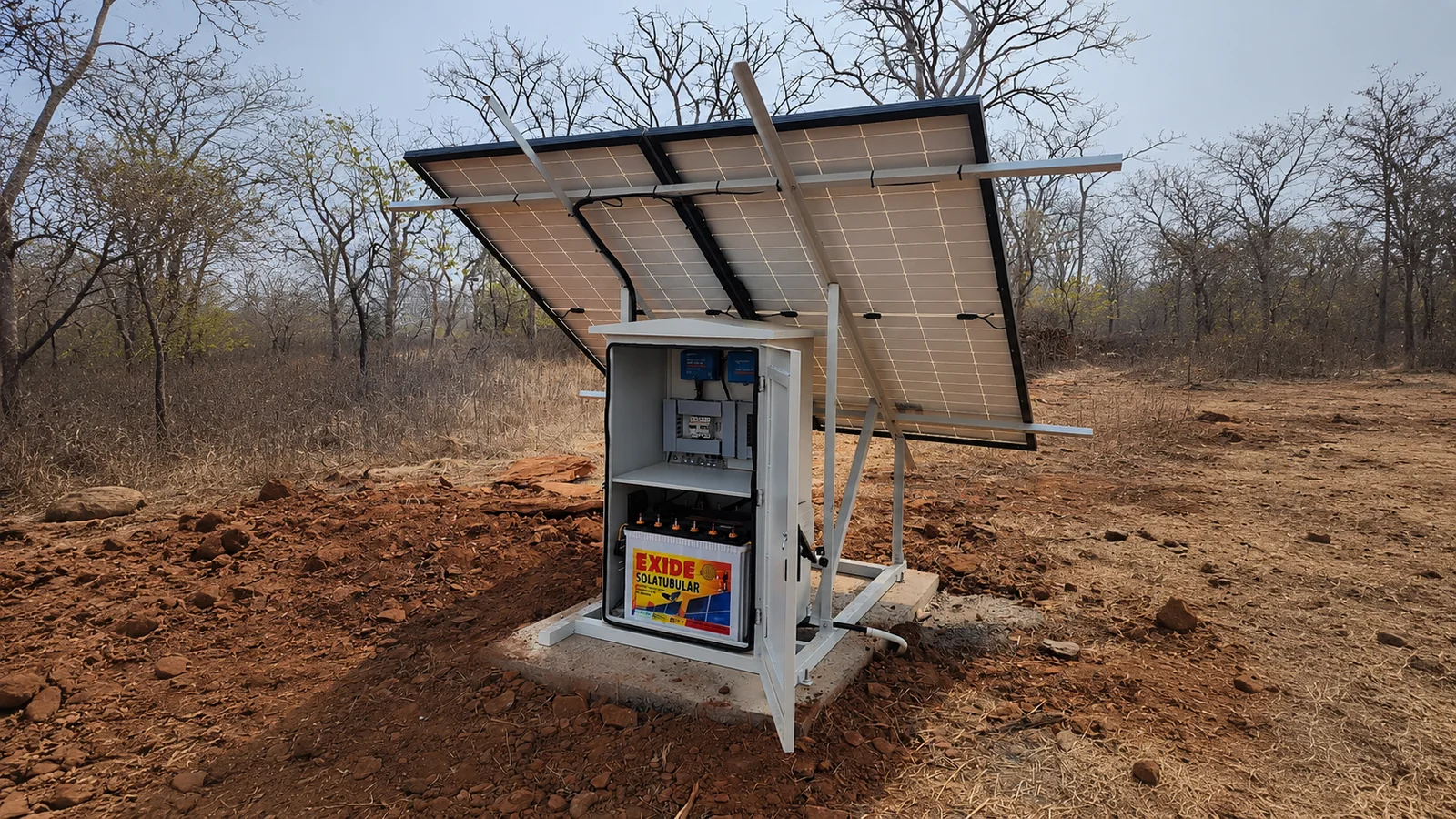
Every remote surveillance deployment eventually comes down to one unglamorous question: will it still be running in the third week of monsoon? Cameras and AI models get the attention, but power is what decides whether a site survives its first year.
Start from the load, not the panel
The most common mistake is picking a panel size first because it fits the budget. Work backwards instead. Add up what the node actually draws, continuously, over 24 hours.
- PTZ camera with IR illuminators — draw rises sharply at night, exactly when solar input is zero
- Thermal or bullet cameras running dual-sensor analytics
- Wireless backhaul radio — modest but constant
- PoE switch and network box overhead
- Edge AI device, if detection runs on site rather than in the control room
Note the asymmetry: peak consumption happens at night, when generation is nil. A system sized on average daily draw without accounting for that curve will brown out at 3 a.m. and recover by morning, leaving you with a log full of gaps and no obvious cause.
Sizing the battery for the worst week, not the average day
Autonomy is the number that matters — how long the site runs with no meaningful solar input at all. In central Indian forest conditions, we design for 20+ hours minimum, which comfortably covers a full night plus a heavily overcast day.
We standardise on LiFePO4 rather than lead-acid for three reasons: usable depth of discharge is far higher, cycle life runs into thousands rather than hundreds, and performance degrades more gracefully in heat. A typical node carries 2.56 kWh. Lead-acid at the same usable capacity would be heavier, shorter-lived, and would need replacing on a schedule that makes remote sites painful to maintain.
“Design for the monsoon week when nobody can reach the site, not for the clear February afternoon when you commissioned it.”
Generation and headroom
Panels rarely deliver rated output in the field. Canopy shading, dust, panel temperature, cable losses and a less-than-ideal tilt all take their cut. We size generation with substantial headroom over theoretical need — a 1.2 kW array against a 2.56 kWh battery on a standard node — and pair it with an MPPT charge controller rather than PWM, because MPPT recovers meaningfully more energy on exactly the weak, diffuse-light days when you need it most.
Mounting matters more than people expect
- Mount panels high — around 3 m — to clear undergrowth and reduce tampering and animal damage
- Angle for the worst season, not peak summer
- Keep a clear cut-line through canopy and plan for how fast it grows back
- Assume dust accumulation and build cleaning into the maintenance schedule
Protection is not optional
A tower with cameras and radios on it is the tallest conductive object in a landscape that gets serious electrical storms. Proper earthing — GI earthing rod, copper bonded, low resistance — plus surge protection on the network side is the difference between a lightning season you notice and one that costs you every camera on the site.
Equally, everything outdoors belongs in an IP65-rated enclosure. Dust ingress during dry months and driving rain during monsoon will find any weakness in a cabinet, and a failed connector three hours from the nearest road is an expensive lesson.
A checklist before you commission
- Measured actual night-time draw, not datasheet typical values
- Battery autonomy verified by running the site disconnected from solar
- Charge controller logging accessible remotely, so you see degradation before failure
- Earthing resistance measured and recorded
- A maintenance plan that names who cleans the panels and how often
Get the power design right and the rest of the system becomes a software problem. Get it wrong and you will spend the next two years driving to site.